Thomas Wolsey
Wolf HallThomas Wolsey’s authority rests on an imposing combination of office, learning, patronage, and performance, but his rise cannot secure him against the king’s changing will. Archbishop of York and Lord Chancellor of England, he plans colleges that will outlive him, serves Henry VIII with consuming devotion, and entrusts Thomas Cromwell with the work that turns his ambitions into policy. His fall strips his household and possessions away; the institutions and political arguments he leaves behind continue to shape the realm.
Identity and Political Method
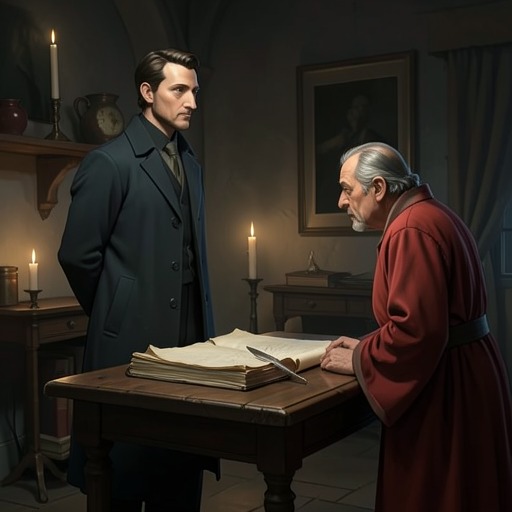
Wolsey is presented through the contrast between princely display and practical purpose. At fifty-five, he remains handsome and physically imposing, dressed for a late-night meeting in blackish purple and fine white lace rather than his customary scarlet. His large, ringed hand rests on his belly; his broad shoulders carry the authority of the Lord Chancellor’s chain, even when he is not wearing it. His manner is as carefully commanding as his appearance: he teases servants and visitors, but his household’s hospitality is constant, and even a guest who has interrupted him night after night remains an honoured one.
His humor makes power feel intimate without making it less real. He jokes that Cromwell commits outrages across the countryside and charges them to his accounts, and that he demands cherries in April and lettuce in December. When Cromwell arrives wet and exhausted from business in the north, Wolsey immediately has the room set in motion for food, wine, and a fire. The scene shows a master who notices the demands made on his servant, but also one whose household operates through an elaborate performance of deference, apology, and care.
That courtly ease coexists with impatience toward obstacles. Wolsey wants to amalgamate about thirty small, poorly run religious foundations with larger institutions and redirect their income to his colleges at Oxford and in Ipswich. He has secured papal permission and insists that the monks need not simply be cast onto the roads: relocation, pensions, and compensation can be negotiated. Yet when Cromwell explains legal impediments, Wolsey would rather find a way through than dwell on the technicalities. His educational purpose is substantial, but so is his expectation that people and property can be made to serve it.
Cromwell, Service, and Patronage
Wolsey’s relationship with Cromwell is built from long service, professional trust, and a shared taste for tactical wit. On returning from Yorkshire, Cromwell reports that local people oppose the cardinal’s project and threaten him. Wolsey asks whether they will actually kill him, then advises that he take an armed guard on his next journey north. He refuses to abandon the college scheme: the selected foundations, he says, have been approved by the Pope, and opposition does not alter his intention. Cromwell, in turn, understands that the opponents want the proceeds for themselves. Their exchange joins affection to a clear-eyed account of power and self-interest.
The trust is visible in what Wolsey asks Cromwell to do. He wants more friends in the household of Katherine of Aragon—not merely companions, but people who can report how she privately receives the news that Henry, after about twenty years with her, wants to marry another woman in the hope of having a son. Wolsey confides the strain of the king’s demands to Cromwell, speaking with love for Henry VIII even as he complains that the king wants an impossible answer to the problem of succession. He expects Cromwell to understand both the emotional loyalty and the political assignment.
Cromwell’s service survives Wolsey’s loss of favor. When the king’s men arrive at York Place to dispossess its owner, Cromwell helps Wolsey delay the surrender of the Great Seal by insisting on the proper written request and the proper official to receive it. Wolsey embraces him afterward, delighted that they have bought twenty-four hours through legal ingenuity. The maneuver cannot reverse the king’s decision, but it demonstrates the shared habits of mind that defined their partnership: procedure is a weapon, timing has value, and even defeat leaves room for one last act of craft.
Ambition and the Cardinal’s Fall
Wolsey’s projected colleges are meant as living monuments, distinct from the grand tomb he has already commissioned from a sculptor from Florence. He imagines the tomb as a lasting memorial in stone and gold, but the colleges as institutions still at work after his death: poor boys and scholars carrying his learning, taste, and sense of decorum into the world. The distinction reveals an ambition larger than personal commemoration. His plans seek to turn ecclesiastical revenues into an enduring educational legacy, although their execution depends on a political authority that can be withdrawn.
That dependency becomes unmistakable in 1529, when the Dukes of Norfolk and Suffolk arrive at York Place, tell Wolsey he is dismissed as Lord Chancellor, and demand the Great Seal. The king’s men then dismantle his household room by room, removing parchments, books, accounts, ink, quills, and even the boards bearing his coat of arms. The palace is to be prepared for Anne Boleyn. Wolsey’s personal magnificence and administrative world are not merely displaced; they are physically taken apart so that a new royal household can occupy the space.
The journey away from York Place brings the human cost into view. As Wolsey’s barge moves upstream, onlookers hoot and boo, and threats follow it along the river. He collapses into his seat and speaks almost continuously to Putney, asking whether the people truly hate him after his years in service, his efforts to promote trade, and his appeals for mercy when hungry people rioted. He remembers begging Henry to spare the apprentices who stood beneath the nooses prepared for their execution. His account is not a neutral verdict on his rule; it is the shocked reckoning of a fallen minister who sees public hostility where he had expected gratitude.
Cromwell and George Cavendish interpret the crowd differently. Cavendish argues that the multitude wants change for its own novelty, while Cromwell says people hope there may be something better. He captures the danger in an image of political replacement: one dog, sated with meat, gives way to a hungrier dog that bites nearer the bone. Wolsey has served a prince for decades, but neither labor nor long familiarity guarantees constancy from the ruler or affection from the governed. His removal is therefore a reversal of rank and a lesson in the instability built into service to a monarch.
Legacy in a Changing Realm
Wolsey remains a political presence after his fall because the people around the king continue to measure themselves against his work. Henry VIII complains that Wolsey was a better manager of affairs than his present council. In the same period, Cromwell explains to the Commons that England’s earlier wars would have ended worse without Wolsey supplying them. The cardinal’s opponents may celebrate his removal, but his administrative competence remains a standard by which the new regime is judged.
His influence also persists in the institutions and methods his career made possible. Cromwell advances into Parliament with Rafe Sadler’s help, securing a seat at Taunton in territory associated with Wolsey and with the consent of both the king and Thomas Howard. Later, as Parliament debates measures against the Church’s jurisdiction and revenues, Cromwell works through the night with Rafe and Thomas Wriothesley, uses a division in the Commons to identify supporters and opponents of a bill restricting annates, and helps the king build support for royal authority. These are not simply the continuation of Wolsey’s program: the new political order turns against Rome and places the Church more firmly under the crown. But Cromwell’s rise and administrative work grow out of skills and connections formed in Wolsey’s service.
The novel also places Wolsey within arguments over what makes authority legitimate. Henry VIII’s new claim to headship of the English Church is contested by Katherine and Mary, who insist on the claims of the Church and the Pope. Cromwell tries to persuade them that royal supremacy can be understood through precedent and qualified by the phrase “as far as the law of Christ allows”; Katherine replies that Wolsey, although her enemy, did not make her love the Church less. Later Cromwell presents Henry with Marsiglio of Padua’s propositions, which deny that Christ created papal temporal power and locate a king’s authority in a legislative body acting for the people. Wolsey’s fallen ministry is the world these arguments replace, but the novel does not reduce that change to a clean break: the new regime inherits its personnel, procedures, and political problems even as it claims a different source of authority.
Narrative Significance
Wolsey’s arc binds personal loyalty to institutional upheaval. His confidence in the educational legacy of his colleges contrasts with the sudden dispossession of York Place; his enduring love for Henry contrasts with the king’s capacity to dismiss him. The contrast makes his fall more than a reversal in court standing. It exposes the vulnerability of a system in which learning, office, service, and carefully cultivated favor can all be swept aside by royal decision.
For Cromwell, Wolsey is both former master and political inheritance. Cromwell’s procedural ingenuity at York Place, his later command of parliamentary tactics, and his continuing defense of Wolsey’s capacity all show the persistence of their bond. Yet he does not simply recreate the cardinal’s position. The political machinery that Cromwell helps operate increasingly asserts the crown’s authority over the Church, reshaping the conditions under which Wolsey himself once wielded power. The cardinal’s fall thus marks both the end of a personal alliance and the opening of a new, contested order.